
Everyday recovery
Your hands clock more hours than any other part of your body. Almost nobody gives them a recovery routine.
We stretch after a run. We foam-roll our backs. We have skincare routines, sleep routines, mobility routines. Then we spend the whole day typing, scrolling, gripping and carrying, and give our hands nothing at all.
A guide from Well Root · Written and paid for by the brand · 6 minute read
Count the hours, not the effort
Nothing about a day at a keyboard feels like exertion. That's exactly why it goes unnoticed. Thousands of keystrokes. Hundreds of clicks. A phone held in the same pinch grip through an entire commute.
One woman who crochets for hours said her fingers lock up so badly she has to peel them open. A butcher said his hands ache so much after a shift he can barely grip a fork at dinner. A software developer said by 3pm he's typing with thick, stiff fingers and still has three hours to go. A rower's father said his son's hands go through more punishment than any other body part, and nobody thinks to recover them.
These are not injuries. This is ordinary fatigue in a part of the body that has been working since breakfast, in small movements nobody bothers to count.
We have a routine for nearly every part of the body that gets tired. Hands are the exception.
The part most people ignore
Four routines you probably have. One you probably don't.
Think about what already has a slot in your week, then notice what is missing.
- 01 Sleep. Tracked, optimised, discussed at length.
- 02 Training and stretching. Warm-ups, cool-downs, rest days.
- 03 Skin. A morning routine and an evening one.
- 04 Back and neck. Cushions, rollers, a massage when it gets bad.
- 05 Hands. Used more than any of the above. Given a routine by almost no one.
The ninety second problem.
Try this right now. Press your thumb into the center of your opposite palm and work it in a slow circle. It feels good immediately. Your hand loosens up. The stiffness starts to fade.
Now notice what your other hand is doing. It is working. It is pressing, gripping, rotating. The hand giving the massage is getting more tired while the hand receiving it gets a minute of relief.
That is why self massage never becomes a routine. It works in the moment, but it asks you to use the exact part of your body you were trying to rest. Most people stop after about ninety seconds, not because it stopped helping, but because the effort outweighed the relief.
The real question isn't whether rubbing your own hands works. It's whether you'll still be doing it next Tuesday.
The mechanism
What air compression actually feels like
Forget what you think a massager feels like. There is no buzzing, no vibrating motor, no rolling balls.
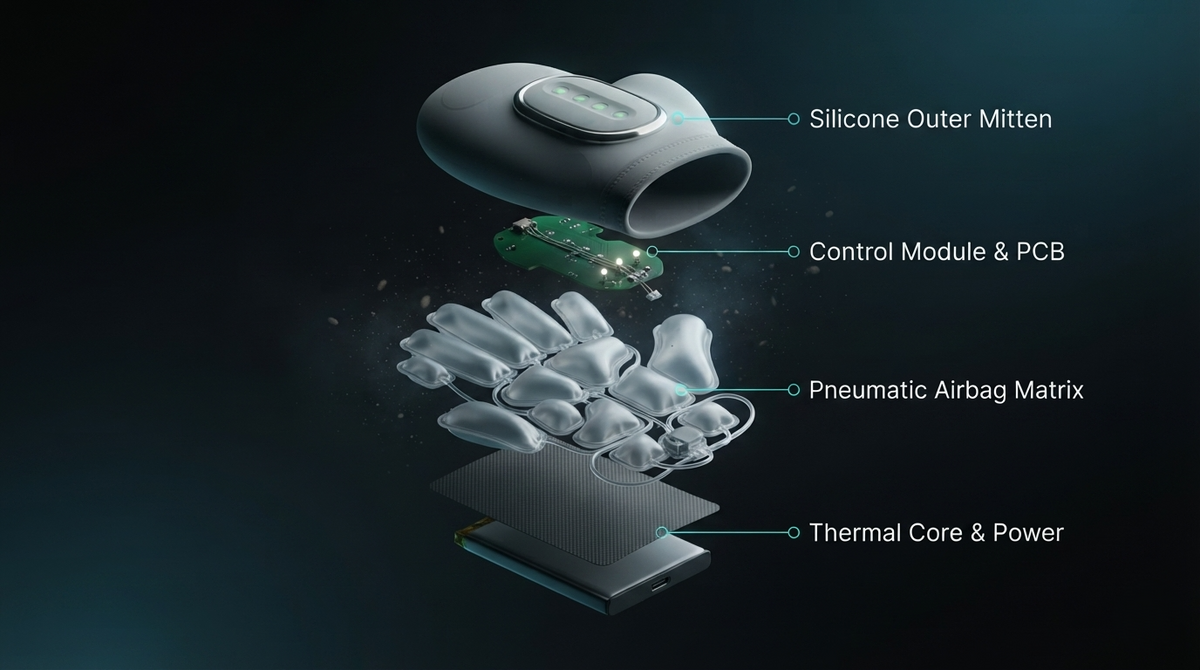
Instead, soft chambers around your hand fill with air, one area at a time. They press gently, hold for a moment, then release. The next area takes over. The sensation is a slow wave of pressure that travels from your wrist, through your palm, and out to your fingernails.
It is closer to someone methodically squeezing your hand than anything mechanical. Firm enough to feel purposeful. Gentle enough that most people close their eyes within the first two minutes.
And then there's warmth
Everyone already knows this part. It's why we hold a mug with both hands in winter, why a hot shower is the best ten minutes of a cold day, why heated seats sell cars.
Warmth changes how a massage feels. It turns "this is nice" into "I am not moving for the next quarter of an hour," especially in the evening, and especially when your hands feel cold and stiff. Nothing clinical about it. It is just more pleasant, and pleasant is what makes a routine stick.
One reviewer put it simply: the heat is what makes you stay. Without it, you use the massager and put it away. With it, you sit there for the full session because your hand feels too good to pull out. That is exactly the difference between a gadget you tried once and something you reach for every evening.
The product
That's where this small hand ritual comes in.
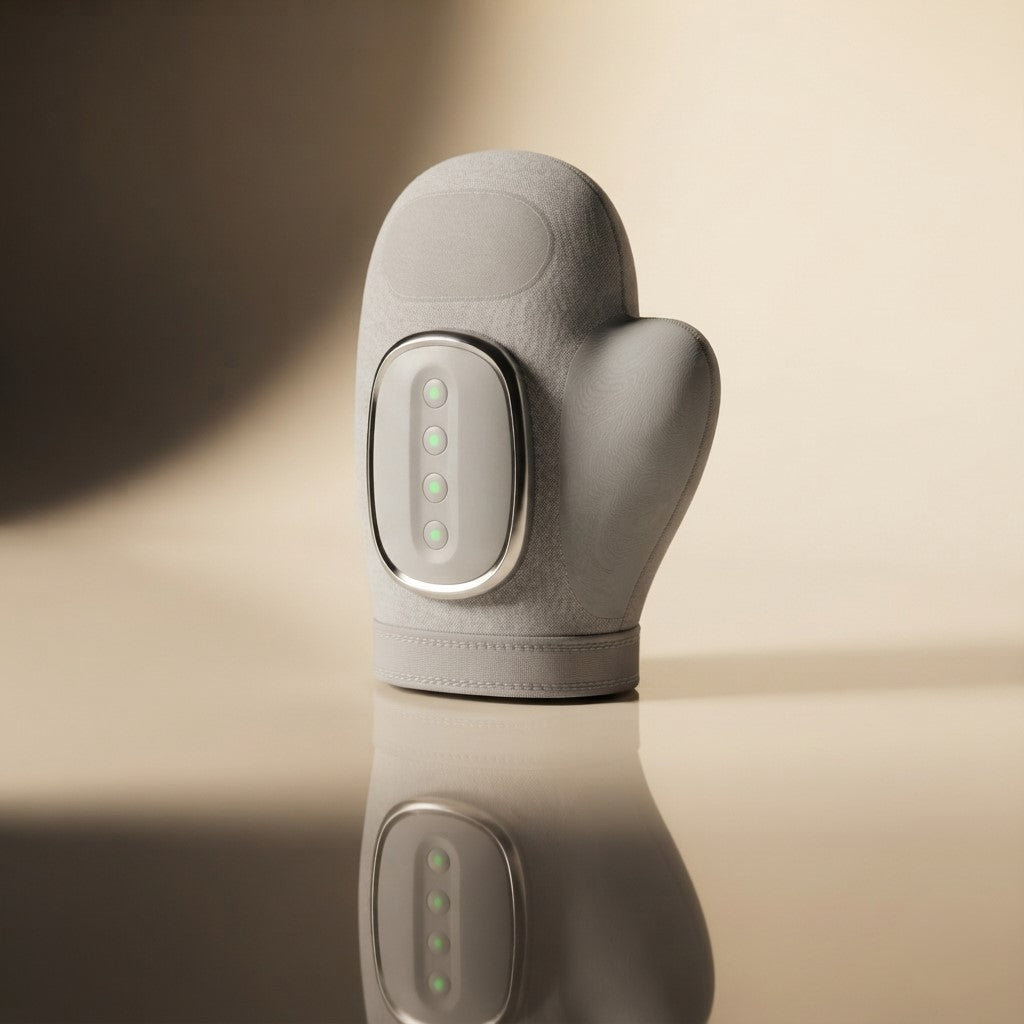
The Well Root Wireless Hand Massager is a soft mitten you slide one hand into. Air chambers inside handle the compression, a heating layer adds warmth if you want it, and four buttons on the back set everything else.
No cable, nothing to hold, nothing to aim. One hand goes in and the other stays completely free, which is really the whole point. That is the difference between a routine you mean to keep and one you actually keep.
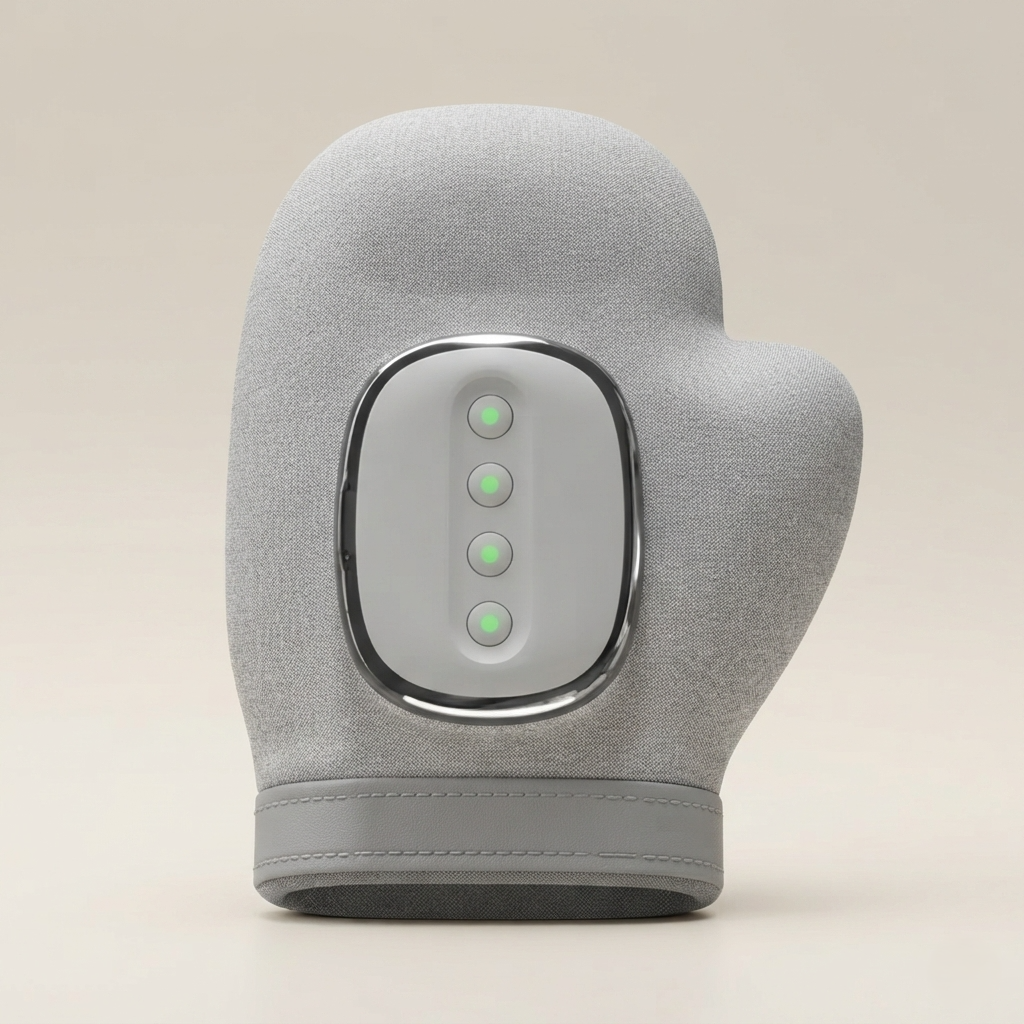
- 01 Wearable mitten design, one size, either hand
- 02 Air-pressure compression across fingers, palm and wrist
- 03 Multi-level warmth, on its own button
- 04 Cordless, with Type-C charging and an auto shut-off timer
Ten minutes. One hand at a time. Starting at $83.99 with free US shipping.
Where it actually fits
This is not another thing to schedule. It slots into the gaps you already have, the moments you are sitting down anyway.
- 01 After work. Laptop shut, mitten on, one hand still free for a cup of tea. A reset after a keyboard-heavy day.
- 02 After training. Bars, ropes and grips ask a lot of the hands. A simple recovery ritual once the session's done.
- 03 In the evening. Warmth on, low pressure, something on TV. Put it on while you unwind and forget it's running.
- 04 At the weekend. After the garden, the DIY, the batch cooking, the endless carrying.
Who tends to appreciate it
Not a list of conditions. A list of lives where the hands do the heavy lifting.
- 01 The keyboard warrior. You don't lift anything heavy. You don't grip anything hard. But by the end of the day your wrists feel locked, your fingers feel swollen, and shaking out your hands only helps for about ten seconds. The soreness is invisible to everyone except you.
- 02 The gamer. Three hours on a controller and your thumbs feel bruised. You shake your hands between matches and tell yourself it's fine. It is fine, until it isn't, and by then you've been ignoring it for months.
- 03 The athlete. Deadlifts, pull ups, kettlebells, climbing walls. You recover your legs, your shoulders, your back. Your hands did the holding for all of it and got nothing afterward.
- 04 The maker. Crochet until your fingers won't open. Drawing until your grip cramps. Sewing, knitting, woodwork, ceramics. The thing you love doing is also the thing that wrecks your hands, and you never take a real break from it because it doesn't feel like exercise.
- 05 The everyday doer. Cooking three meals. Wringing out laundry. Carrying grocery bags with four fingers. Pulling weeds for an hour. None of it feels strenuous in the moment. All of it adds up by 9pm.
- 06 Anyone who just wants to relax. No qualifying lifestyle required. Warmth and slow compression on tired hands is simply a nice thing to experience, the same way a hot bath is nice even when nothing specifically hurts.
The combination is the point
Compression on its own is good. Warmth on its own is good. Neither one asks anything of you, and that is what makes it repeatable.
- 01 vs. doing it yourself. Same idea, but the mitten does the pressing so neither hand has to work. That is why a session lasts ten minutes instead of ninety seconds.
- 02 vs. skipping it entirely. Most people do nothing for their hands. Not because they don't feel the stiffness, but because there has never been a simple option. This is the simple option.
- 03 vs. vibration massagers. Vibration buzzes against the skin surface. Air compression presses and releases through the whole hand. Different sensation entirely. Some people strongly prefer one over the other, and that is worth knowing before you buy.
Which you prefer is personal. Some people love air-pressure massage; some don't. We'd rather say that than claim it suits everyone.
Using it sensibly
What this is, and what it isn't
It is a comfort and relaxation device, not a medical one. We don't present it as a treatment for arthritis, carpal tunnel syndrome, injuries, inflammation or circulation problems. If you have a medical concern, reduced sensation in your hands, swelling or a skin condition, speak to a clinician before using it. Follow the manual, keep the mitten dry, and stop if anything feels too warm or uncomfortable. Individual experiences vary.